Travel Planner
“ATV Fun”
Episode #2205 / 2209 Travel planner
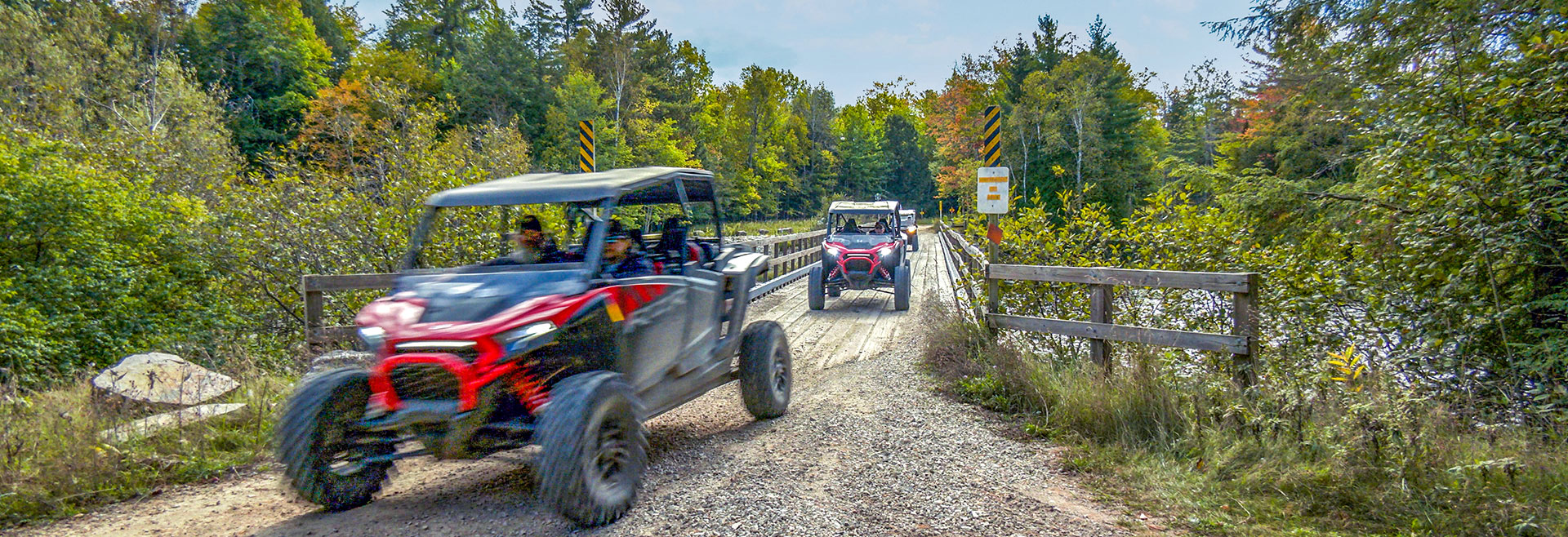
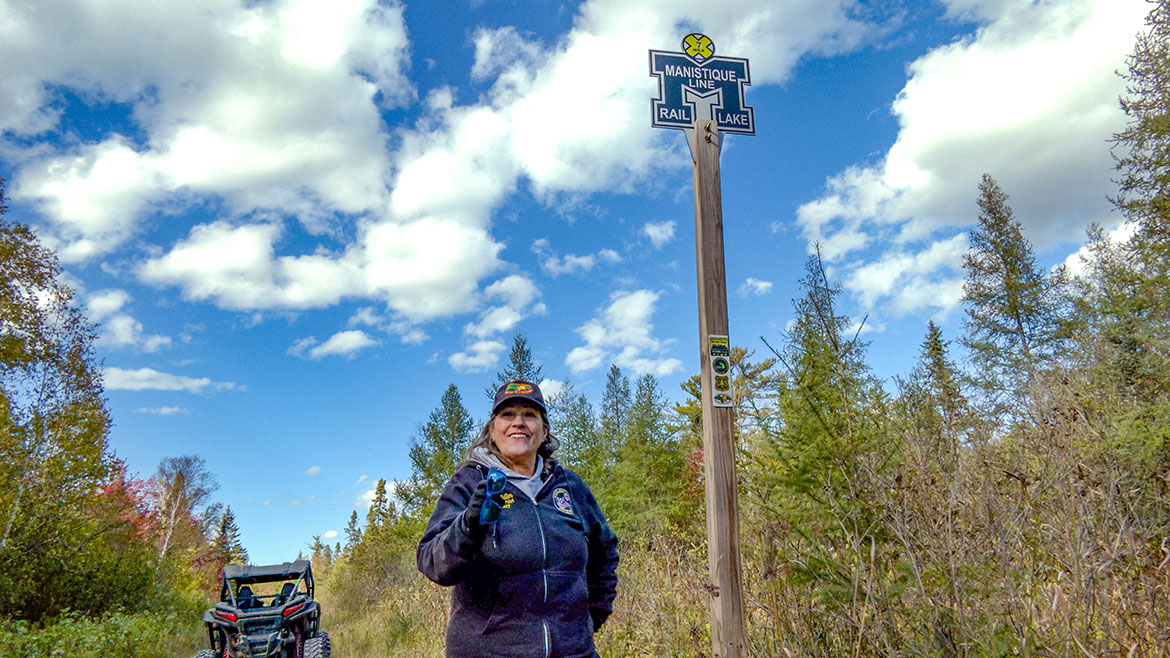
Riding an ATV in Michigan’s Upper Peninsula is an exhilarating adventure, with miles of rugged trails weaving through dense forests, over rolling dunes, and past breathtaking rivers. We travel a hundred miles on ATVs in the back woods.
We continue our historic journey up the Haywire Grade Trail. This old railroad grade from the late 1800s is now a trail for fun and education. Historical kiosks are placed throughout the trail to provide information on its past significance.

Comment
Tell us what you thought of this episode and get information about the areas featured by filling out the comment form
Comment Form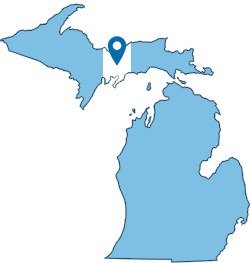
Central Upper Peninsula, Michigan

Haywire Grade Trail
INTAKE PARK TRAILHEAD
Location: Intake Park Road - Manistique, Michigan (across from Manistique Pumping Station)
Trail: 32 miles between Manistique and Shingleton
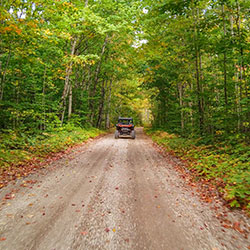
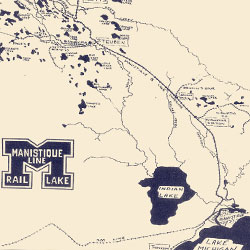
The multiuse Haywire Grade Trail stretches 32 miles and crosses the Upper Peninsula, south to north, from Intake Park in Manistique to Shingleton in Schoolcraft and Alger counties. The trail was Michigan’s first rail trail. The trail runs along the old Manistique and Lake Superior Railroad and has since been reclassified as a year-round, multiuse trail – the first in Michigan's Upper Peninsula.
The trail surface is a mix of sand, gravel and coarse limestone, designed for snowmobiles and ATVs, but suitable for fat-tire biking. Mile markers help you track your progress through this secluded second growth forest. You’ll find a small grocery store in the tiny hamlet of Steuben, the last vestige of the many logging camps or towns that vanished after the railroad was abandoned. Converted into a recreation trail in 1970, the Haywire Grade Trail celebrated its 50th anniversary in 2020 with special events and commemorate rides for snowmobiles, equestrians, bicycles and ORVs.
The trail has been recognized as a Pure Michigan Designated Trail and designated as a heritage trail. The heritage trail project includes a series of 11 historical interpretive kiosks that explore the natural and cultural history of the area
- Haywire Grade Trail [Michigan DNR]
- Haywire Grade Trail [Visit Manistique]
ATVs in Schoolcraft County
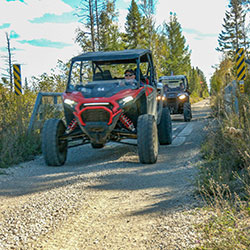
Location: Schoolcraft County, Michigan
Challenging trails for the off-road enthusiast can be found throughout the Manistique area, including the Haywire Grade Trail. Riding opportunities abound along abandoned railroad grades for a near straight jaunt. Hundreds of miles of scenic and historic trails are ready for today’s rider.
- ORV Riding [Visit Manistique]
Schoolcraft County Motorized Trails Association
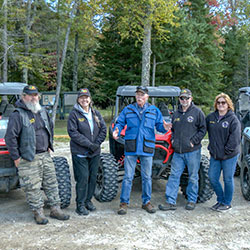
Location: 300 New Delta Ave, Manistique, Michigan
Phone: (906) 341-4488
They maintain the trail system in their sector of the Central Upper Peninsula of Michigan. The SCMTA strives to provide a medium for exchange of snowmobile and ORV information and to be the catalyst between government entities, businesses and snowmobilers and ORV enthusiasts.
- SCMTA [Facebook]
Manistique River Station
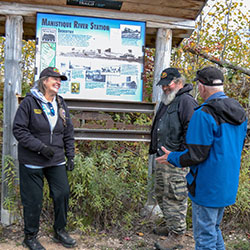
Location: near mile marker 1 - Haywire Grade Trail
INDUSTRY
During the big pine logging era of the late-19th and early-20th centuries, the Manistique River Station was an important stop on the Haywire rail line. Its location along the river made it ideal for transporting logs to the mills and factories that sprang up in the area. By 1924 the logging era was over and the station closed permanently.
The nearby Manistique & Lake Superior track had a triangle section of track called a wye, which made it possible to turn the train in the opposite direction.
1887 - In 1887 Abijah Weston started the Manistique Iron Company, which melted iron ore pellets to produce pig iron. It was later renamed the Charcoal Iron Company of America. It went bankrupt in 1923.
1889 - Access to the area’s dolomite deposits and slab wood fuel led George Nicholson to establish the White Marble Lime Company in 1889.
1907 - The Goodwillie Brothers Box Factory (1907-1920) manufactured custom boxes and crates. The factory was extensively damaged in a flood and never reopened.
1910 - In 1910 the Manistique Handle Company began to produce handles for brooms and feather dusters using woods such as maple, beech and birch. Charles Slining Sr. purchased the factory and renamed it the Northwoods Manufacturing Company in 1929.
1916 - Thomas Berry Chemical Company produced chemicals distilled from wood. During World War I the company produced acetone for the military. Acetone was used in the manufacture of cordite, a smokeless propellant that replaced gun powder.
- Haywire Grade Trail [Visit Manistique]
Sturgeon Hole
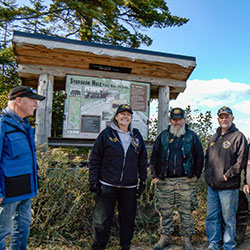
Location: mile marker 5 - Haywire Grade Trail
FROM RAIL TO TRAIL
Sturgeon Hole Station was a sportsman's stop on the Manistique & Lake Superior Railroad. People were drawn to Sturgeon Hole Creek for trout fishing, while a large deer herd attracted hunters.
THE "HAYWIRE"
The origin of the nickname "Haywire" is unknown. Hugh Hornstein, in his book The Haywire, notes three theories stemming from its railroad history.
- 1. "Temporary repairs to railroad equipment were made with wire taken from bales of hay fed to lumber camp horses"
- 2. "Bailing wire was used to secure logs to Russell cars."
- 3. "Section crews responsible for repairing the rails claimed that they were made of hay wrapped with wire."
COMBINED EFFORTS
When the Manistique & Lake Superior Railroad ceased operations in 1968, the conversion of abandoned rail corriders into trails was rare. However, the growing popularity of snowmobiling brought new life to the Haywire. In 1970 a series of land transactions between Schoolcraft and Alger Counties, Hannah Mining Company, the U.S. Forest Service and the Michigan Department of Natural Resources established the Haywire as Michigan's first rail-trail. This pioneering effort was Michigan's first step in becoming the nation's premier trail state, with more miles of rail-trail than any other state by 2020.
TIME LINE
- 1896 - Manistique & Northwestern Railroad opens
- 1909 - Line renamed Manistique & Lake Superior Railroad
- 1968 - Manistique & Lake Superior abandons railroad
- 1970 - Haywire opens as a motorized trail, Michigan's first rail trail
- 2017 - Heritage mile markers installed
- 2020 - 50th Anniversary; Interpretive kiosks installed
- 2020 - Haywire designated as a Pure Michigan Trail
- Haywire Grade Trail [Visit Manistique]
Station Nine
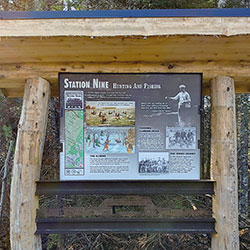
Location: near mile marker 8 - Haywire Grade Trail
HUNTING AND FISHING
In this region people hunt and fish for food, recreation or sport. Though their motives may be different, the wildlife here provides ample game.
Many men go fishing all of their lives without knowing that it is not fish they are after. -Henry David Thoreau
THE OJIBWE
The Ojibwe people believe all animals have a spirit. If you take the life of an animal, you must offer it thanks with the sacred medicine of Asemaa (tobacco) for giving its life to you and your family.
Historically, the Ojibwe hunted and trapped animals like beaver, deer and raccoon, and used the meat for food and hides for clothing. Today, they mainly hunt game like partridge, rabbit, duck and deer.
FEEDING LUMBERJACKS
Chicago Lumbering Company camps often employed a hunter to keep the cooks supplied with fresh meat. William Crowe, in his classic book Lumberjack, reports that the hunter for the George Hovey camp at Doe Lake bagged 75 deer in one winter without ever leaving the camp.
THE BYERS FAMILY
In 1883 Abraham Byers and his large family settled in Hiawatha Township. Wild game was plentiful and he hunted regularly for fresh meat. Abe Byers’ youngest son, David, estimated that his “father’s family of seven boys killed . . . in the neighborhood of 2,500 deer” between 1882 and 1892.
- Haywire Grade Trail [Visit Manistique]
Hiawatha Station
Location: mile marker 9 - Haywire Grade Trail
AN EVOLVING COMMUNITY
Also known as Hiawatha Junction, this was the site of a spur line that ran east toward the Hiawatha mill and post office. Other businesses included a lumber camp, hotel, sawmill and cattle companies. In 1900 the population was 185.
ABRAHAM BYERS AND THE HIAWATHA VILLAGE ASSOCIATION
Abraham Byers came to Hiawatha in 1885 to stake 10 homestead claims for himself and 9 relatives. Totaling 1,600 acres, the settlement prospered until the financial panic of 1893. In order to keep his land, Byers partnered with socialist Walter Thomas Mills in 1894 to establish a cooperative community.
Named the Hiawatha Village Association, the community supported 225 people on 1,060 acres of land. The experiment failed in 1895 when members left the commune due to poor business practices and disagreements over housing.
THE FOX FARM
In 1927 George Banzhaf and John Nieman began raising silver foxes on 80 acres near here. The farm supported up to 100 breeding pairs that survived on a diet of horse meat, grain and vegetables. The local geology played a role in the farm’s success. With the limestone bedrock close to the surface, the foxes were unable to tunnel under and out of their pens.
The farm, named the Rockville Company after the terrain, sold fox pelts at markets in New York and across the United States until 1949.
THE "OLD LADY"
In the 1920s station crew foreman George Smart was determined to stop a porcupine from gnawing on his front step. He struck the animal with a stove poker and left it for dead.
Mr. Smart’s children found the animal and nursed it back to health. Named “Old Lady,” the porcupine adapted well to captivity and gave birth to several large litters. Soon, tourists began to visit Hiawatha Station to see the porcupines.
- Haywire Grade Trail [Visit Manistique]
Beeson's Spur
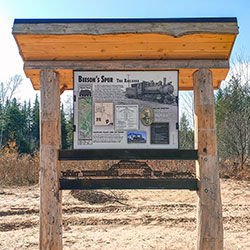
Location: near mile marker 12 - Haywire Grade Trail
THE RAILROAD
In 1891 the Manistique & Northwest Railway Company (M&N) received a Michigan charter in order to increase lumber shipments to Manistique mills. After four years of planning, it took three years more to construct the train tracks from Manistique to Shingleton. The railroad went through two name changes before being purchased by the Manistique & Lake Superior Railroad Company (M&LS) in 1909. Along the way it acquired the nickname Haywire.
SHIPPING TRAIN CARS ON WATER
In 1897 the Ann Arbor Railroad began a ferry service between Manistique and ports on the lower peninsula. This made it possible for the company to transport train cars across Lake Michigan. By the 1920s automobiles used the ferry as well. The boat route to Ludington was the secondlongest on the Great Lakes at 138 miles and 11.5 hours. Ferry service to Manistique ceased operations in 1968.
ABIJAH WESTON
In the late 1800s New York native Abijah Weston founded the Chicago Lumber Company and several other businesses in the Manistique area. Weston was the primary supporter for construction of what became the Manistique & Lake Superior Railroad.
TIME LINE
- 1891 - The Manistique & Northwestern Railway Company is organized
- 1895 - Construction of railroad begins in Manistique
- 1897 - Railroad car ferry service begins at Manistique
- 1898 - Construction of railroad reaches Shingleton
- 1899 - Passenger service between Manistique and Shingleton begins
- 1902 - New ownership. Name changed to Manistique, Marquette & Northern Railroad
- 1908 - Railroad reorganized and renamed Manistique & Northern Railroad
- 1909 - Manistique & Lake Superior Railroad Company purchases the line
- 1968 - Manistique & Lake Superior Railroad Company and railroad car ferry service cease operation
- Haywire Grade Trail [Visit Manistique]
Jack Pine Lodge

Location: 5350N State Hwy M-94, Manistique, Michigan
Phone: (906) 573-2414
Hours: Sun-Thu 12-8pm | Fri-Sat 12pm-12am
Jack Pine Lodge is a Campground, nostalgic Bar & Grill, and resort located in the Hiawatha Forest in Michigan's U.P. between Pictured Rocks & Big Spring. The current log restaurant and bar building were built in 1946. The new campground was completed in 2014. The six rental cabins were built in the 1950s and have been refurbished in 2009. This Hiawatha National Forest area is an outdoor enthusiast’s playground offering access to miles of groomed snowmobile & ORV trails, great hunting, fishing, hiking, canoeing, cross-country ski trails, and horseback riding trails. The Jack Pine Lodge's Bar and Grill offers a full bar and menu and specializes in handcrafted pizzas. The Lodge is host to many annual events such as the Annual Long Riders Relic Ride, Snowmobile, ATV, Pig Roasts, Motorcycle Poker, and other exciting events.
Steuben

Location: near mile marker 19 - Haywire Grade Trail
CIVILIAN CONSERVATION CORPS
On April 17, 1933, the Civilian Conservation Corps (CCC) was created by President Franklin Roosevelt to provide jobs for unemployed men during the Great Depression. Seventeen days later, Camp Steuben opened. The camp's first recruits slept in tents. When not fighting fires or planting trees, the CCC enrollees built wooden barracks to live in. They completed the task by fall. At its peak the camp housed 204 enrollees. Camp Steuben closed in 1941 and its structures and equipment were sold at auction the following year.
STEUBEN
From the late 1800s through the 1930s, the town of Steuben supported its residents and nearby logging operations with a hotel, store and post office. The Chicago Lumbering Company kept a large barn in town to shelter their horses.
- Haywire Grade Trail [Visit Manistique]
- CCC In Michigan [Michigan History Center]
Scotts

Location: mile marker 25 - Haywire Grade Trail
LOGGING CAMPS
Logging camps, like this one near Steuben, housed and fed work crews. Located near rivers and railroad sidings, camps were found all along the Haywire.
PIONEER LUMBERMAN
George Johnston Scott moved from Ontario, Canada to Manistique in 1881. He worked for 3 decades as a camp foreman for the Chicago Lumbering Company. This train station was named after him. He died on April 10, 1924, in Manistique.
HARVESTING TREES
Trees were notched by timber fitters, then cut down by two sawyers. After the trees' limbs were removed, crews sawed them into logs. The preferred log length was 16 feet.
TRANSPORTING LOGS
In the 1880s logging operations rapidly expanded in the Upper Peninsula, after much of the prized white pine in Michigan’s Lower Peninsula had been cut down. The region’s swampy terrain caused most log harvesting to be done in winter when horses or oxen could haul logs on ice roads to riverbanks. In the spring, the logs were then floated south on the Indian and Manistique rivers to Manistique sawmills.
In 1896 the Chicago Lumbering Company built what would become the Manistique & Lake Superior Railroad — also known as the Haywire. This allowed logs to be pulled out of the Indian River at Steuben, hauled eastward by rail and dumped into the Manistique River.
- Haywire Grade Trail [Visit Manistique]
McInnes

Location: mile marker 27 - Haywire Grade Trail
WILDLIFE
A wide range of wildlife lives along the Haywire Grade. Take a minute to look around you and listen. What do you see? What do you hear?
MAMMALS, REPTILES, BIRDS
Wildlife names are listed in both English and Ojibwe. Gray Wolf (Maa'iingan), Coyote (Ezhigashkiid Nimosh), Moose (Mooz), Cougar (Bgoji Gaazhak), Black Bear (Makwa). Garter Snake (Ginebeg), Painted Turtle (Mskwaadesii), Snapping Turtle (Mshiikenh). Check nearby waterbodies for painted turtles lying on logs, basking in the sun. Steer clear of snapping turtles; they bite. Bald Eagle (Migizi), Hummingbird (Naanooshkaanhs), Kirtlands Warbler (Biipiikenh), Wild Turkey (Mizise).
LOGGING AND TRAINS
The McInnes stop had a passing track where trains traveling in opposite directions could pass each other. It also served nearby logging operations. This photo of a nearby banking ground is where logs were put into the river and floated to the saw mills in Manistique.
- Haywire Grade Trail [Visit Manistique]
Richardson

Location: mile marker 29 - Haywire Grade Trail
Richardson was a stop on the Manistique & Lake Superior Railroad. It was most likely named for James Richardson, an employee of the Chicago Lumbering Company during the 1890s. There may have been a short spur to a logging camp. Little else is known about this location.
FIGHTING SNOW
Lake effect snow on the north end of the Haywire Grade comes from Lake Superior. While it is great for snowmobiles, snow could halt the trains that ran here from 1896 to 1968. In January 1911 a winter storm covered the tracks with more than 9 feet of snow, blocking rail traffic for 2 days. A 1929 storm dumped so much snow that it took crews 5 days to clear the tracks.
OFF THE RAILS
Snow not only buried trains but could cause them to derail and wreck. In March 1920, just south of Steuben, a major snowstorm led to a wreck that closed the Manistique & Lake Superior Railroad for several days.
CLEARING THE TRACKS
In order to clear snow on the Haywire, two locomotives, several flat cars and a section crew rode from Manistique to the blocked section of track.
After the lead engine was disconnected, it plowed into the snow at a high rate of speed to either move the snow or bury itself. To pull the engine back out, the second locomotive and flat cars were reattached with 16 inches of slack chain between the flat cars.
As the second engine moved in reverse, it created a quick jerk in the chains which helped pull the lead engine free. If the engine was still stuck, section crews shoveled it out by hand.
- Haywire Grade Trail [Visit Manistique]
Shingleton

Location: near mile marker 32 - Haywire Grade Trail
LOCALS AND THE TRACKS
In 1882 the Detroit, Mackinac & Marquette Railroad built a depot here and called it Jeromeville to honor Michigan’s first native-born governor, David Jerome. The name changed to Shingleton when James Carr started a shingle mill operation. Timber drove the town’s economy, and a great mix of European immigrants arrived to cut down trees and work at the mills. As Shingleton grew, it gained “boisterous saloons and rough characters.”
As bicycles became more popular in the 1890s, Schoolcraft County resident Reginald Ruggles adapted one for the tracks. It made it easier to reach camps, stations and sportsman’s stops along the Haywire.
In 1936 railroad mechanic S.P. Reid converted a 1923 Buick sedan into a delivery car that could run on the tracks. Mail went in the Buick’s trunk and an average of three people rode each day. Driver Laverne Niles claimed it could travel up to 65 mph, but he never traveled that fast. The vehicle’s snowplow stayed on year-round to prevent the car from being derailed by porcupines that wandered onto the tracks.
The Manistique and Northwestern Railway was completed in 1898. In 1909 it was sold to the Manistique and Lake Superior Railroad, also known as the Haywire.
Laverne Niles, his son and their dog pose on a track-maintenance car. Crews drove this gasoline-powered vehicle on the train tracks so they could inspect and keep the rails in shape.
- Haywire Grade Trail [Visit Manistique]